
- Home
- Costa Rica
- Trade agreements
 Costa Rica
Trade agreements of Costa Rica: countries and dates
The 18 agreements that Costa Rica’s Ministry of Foreign Trade lists as in force, with the partner countries and the date each one started to apply, and the two that matter when the cargo comes from the United States or Canada.
- In force18 agreementsCOMEX list, November 2026
- With the United StatesCAFTA-DRSince 1 January 2009
- With CanadaBilateral agreementSince 1 November 2002
- Most recentUnited Arab EmiratesSince 1 April 2025
Agreements in force, oldest first.
Source read 17 November 2026 · indicative only
| Agreement | With | In force for Costa Rica since |
|---|---|---|
| Central American economic integration | El Salvador, Guatemala, Honduras and Nicaragua; Panama joined later | 23 September 1963 |
| Central America and Chile, with a Costa Rica and Chile protocol | Chile | 15 February 2002 |
| Central America and the Dominican Republic | Dominican Republic | 7 March 2002 |
| Free trade agreement with Canada | Canada | 1 November 2002 |
| Free trade agreement with CARICOM | Trinidad and Tobago, Guyana, Barbados, Belize and Jamaica | 15 November 2005 |
| Central America and Panama, with a Costa Rica and Panama protocol | Panama | 24 November 2008 |
| CAFTA-DR | United States, Dominican Republic, El Salvador, Guatemala, Honduras and Nicaragua | 1 January 2009 |
| Free trade agreement with China | China | 1 August 2011 |
| Free trade agreement with Peru | Peru | 1 June 2013 |
| Mexico and Central America | Mexico | 1 July 2013 |
| Free trade agreement with Singapore | Singapore | 1 July 2013 |
| Association agreement between Central America and the European Union | European Union | 1 October 2013 |
| Central America and the EFTA states | Iceland, Liechtenstein, Norway and Switzerland | August and September 2014 |
| Free trade agreement with Colombia | Colombia | 1 August 2016 |
| Central America and Korea | South Korea | 1 November 2019 |
| Association agreement between Central America and the United Kingdom | United Kingdom | 1 January 2021 |
| Trade association agreement with Ecuador | Ecuador | 1 October 2024 |
| Comprehensive economic partnership with the United Arab Emirates | United Arab Emirates | 1 April 2025 |
The CARICOM agreement applies with five of the Caribbean states that signed it: Trinidad and Tobago from 2005, Guyana and Barbados from 2006, Belize from 2011 and Jamaica from 2015. The agreement with the EFTA states started on a different day for each of them, between 19 August and 5 September 2014. For the European Union, the date is that of the trade part of the association agreement.
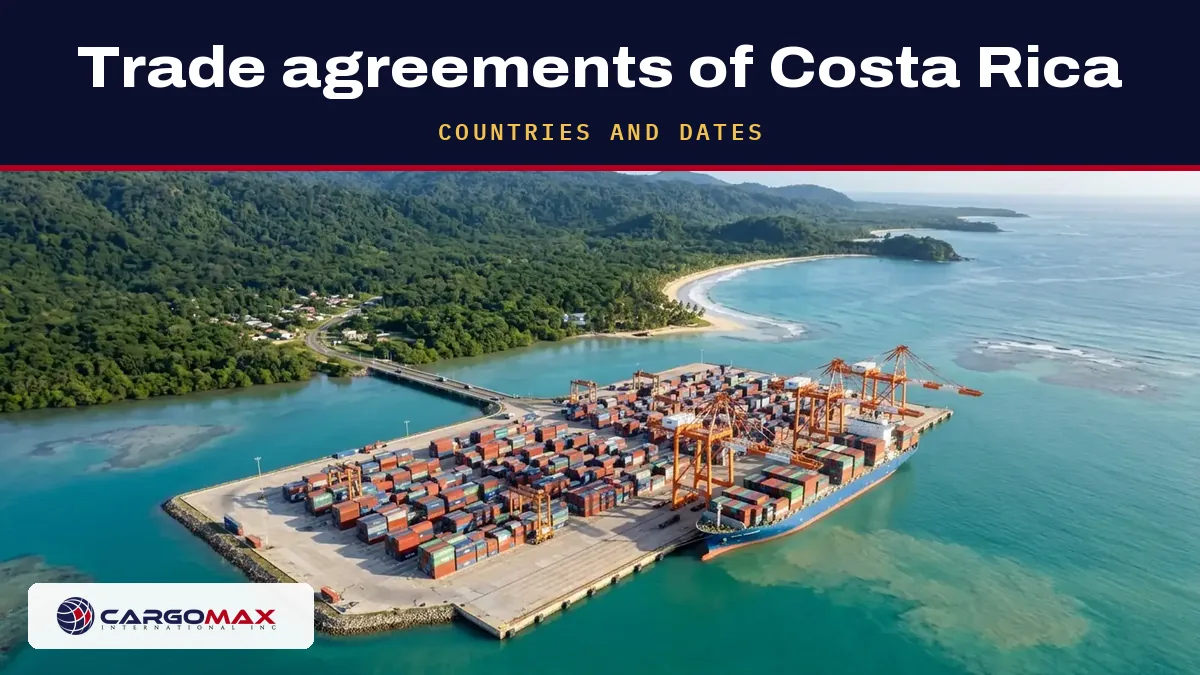
The two agreements behind most of the cargo we ship.
We load for Costa Rica in the United States and in Canada.
- From the United States: CAFTA-DR. One agreement for the United States, the five Central American countries and the Dominican Republic. For Costa Rica it started on 1 January 2009, later than for its neighbours.
- From Canada: the bilateral agreement. In force since 1 November 2002, the oldest of Costa Rica’s agreements with a country outside Latin America.
- Origin, not port of loading. Both agreements favour goods that originate in a member country under their rules of origin. Where the vessel was loaded does not decide it.
- The certificate. COMEX places both agreements among those where the certificate of origin is issued by the exporter, the producer or the importer, without the endorsement of an authority.
Indicative only, not customs advice. Whether a product qualifies, and what duty remains, is decided by Costa Rican customs on the rules of origin and the tariff schedule of the agreement. Have a customs broker in Costa Rica confirm it before you price the goods.
Two ways to certify, depending on the agreement.
As COMEX describes them.
| How it is certified | Agreements |
|---|---|
| By the exporter, producer or importer | CAFTA-DR, Canada, Central America, Chile, Mexico, Panama, Dominican Republic, Singapore, Korea |
| Endorsed by a competent authority | EFTA, China, Colombia, CARICOM, Ecuador, United Arab Emirates, Peru, European Union, United Kingdom |
For the European Union, the United Kingdom and the EFTA states, COMEX adds that an origin declaration on the invoice is accepted from an approved exporter, or from any exporter for consignments of up to 6,000 euros.
We carry the cargo and issue the bill of lading. The certificate of origin is the exporter’s document: send it to the consignee with the commercial invoice so that the broker can claim the preference when the entry is filed.
What is still in process.
Listed by COMEX apart from the agreements in force.
- CPTPP. Marked as shelved. The COMEX page states that on 28 October 2026 the President announced that Costa Rica would not sign the accession protocol.
- Israel. No treaty has been signed. The page records a memorandum of understanding of March 2023 and, in October 2024, the decision to continue towards a negotiation.
- Pacific Alliance. Costa Rica has asked to join and is waiting for the answer.
Where these dates come from.
Every agreement and date on this page was read on the website of COMEX, Costa Rica’s Ministry of Foreign Trade, on 17 November 2026, and compared with the regional trade agreements database of the World Trade Organization. The two agree, except for Panama, where the WTO gives 23 November 2008 and COMEX 24 November 2008; we show the ministry’s date. The agreements with Ecuador and the United Arab Emirates appear on COMEX only.
Sources: COMEX, trade agreements · COMEX, certification of origin · WTO, regional trade agreements database.
Shipping to Costa Rica.
Costa Rica’s trade agreements, answered.
How many trade agreements does Costa Rica have?
The Ministry of Foreign Trade, COMEX, lists 18 trade agreements in force in November 2026, from the Central American integration treaty of 1963 to the partnership with the United Arab Emirates of April 2025.
Does Costa Rica have a free trade agreement with the United States?
Yes. It is CAFTA-DR, the agreement between the Dominican Republic, Central America and the United States. COMEX gives 1 January 2009 as its entry into force for Costa Rica.
Does Costa Rica have a free trade agreement with Canada?
Yes, a bilateral one, in force since 1 November 2002 according to COMEX.
Is Costa Rica part of the CPTPP?
No. COMEX lists the accession as shelved: its page states that on 28 October 2026 the President announced that Costa Rica would not sign the accession protocol.
Does Costa Rica have a free trade agreement with China?
Yes. The agreement with China has been in force since 1 August 2011, according to COMEX.
Who issues the certificate of origin?
It depends on the agreement. COMEX separates agreements where the exporter, producer or importer issues the certificate, such as CAFTA-DR and Canada, from those where an authority must endorse it, such as China, Colombia and the European Union.
Does my cargo pay less duty because it ships from the United States or Canada?
Not for that reason alone. An agreement benefits goods that originate in a member country under its rules of origin, and the importer has to claim it with the certificate. A product made elsewhere does not qualify because it was loaded in Newark or Montreal. Ask the customs broker in Costa Rica before you count on the saving.
Shipping goods to Costa Rica?
Tell us what they are and where they were made. We quote the freight; your broker confirms the duty.
 Argentina
 Bolivia
 Brazil
 Chile
 Colombia
 Dominican Republic
 Ecuador
 El Salvador
 Guatemala
 Honduras
 Nicaragua
 Panama
 Paraguay
 Peru
 Uruguay
 Venezuela
 Belize
 Jamaica
 Puerto Rico